Why the Zip on Your Mid Layer Does More Than an Extra Layer Would
Quick Answer: Most heat leaves the body through the chest, neck, and head, and a zip sits directly over that area. Opening a zip four to six inches vents heat continuously and reversibly, while removing a layer dumps it all at once and leaves you cold three minutes later. Choose layers by zip length rather than by warmth, and you need fewer of them.
You were cold, then hot, then cold again, and you changed layers twice to get there.
A zip would have handled all three states without you stopping once.
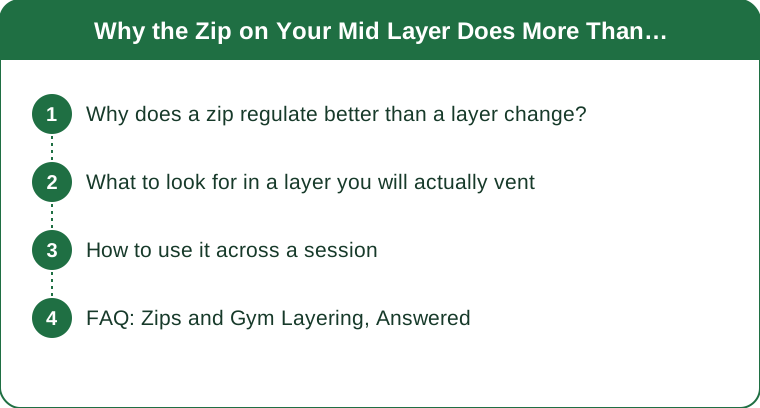
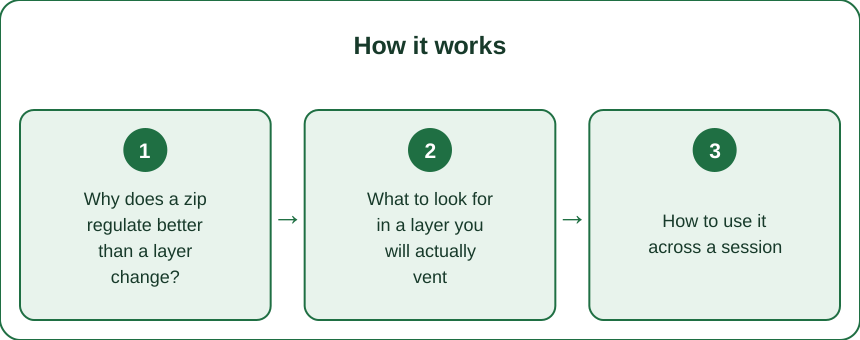
Why does a zip regulate better than a layer change?
It is continuous rather than binary. A zip gives you every position between fully closed and fully open, whereas a layer is on or off with nothing in between - and the temperature you actually want is almost always in between.
It sits over the highest heat-loss area. The chest, upper back, and neck lose heat quickly, which is why opening a collar produces such a fast change relative to how little fabric moved.
It is instant and reversible. Removing a layer takes twenty seconds, needs somewhere to put it, and cannot be undone quickly when you cool down between sets.
And it prevents the overshoot. Taking a layer off when you are already too warm means you are still too warm for a minute and then too cold for five, which is the cycle most people repeat through a whole session.
The physiological reason it works so well is that sweat evaporation cools you, and it needs airflow. A zip creates a chimney effect that moves air over damp skin without exposing you to a full temperature change.
Which reframes what makes a good mid layer. Warmth matters less than the length of the zip and how easily you can move it one-handed mid-set.
What to look for in a layer you will actually vent
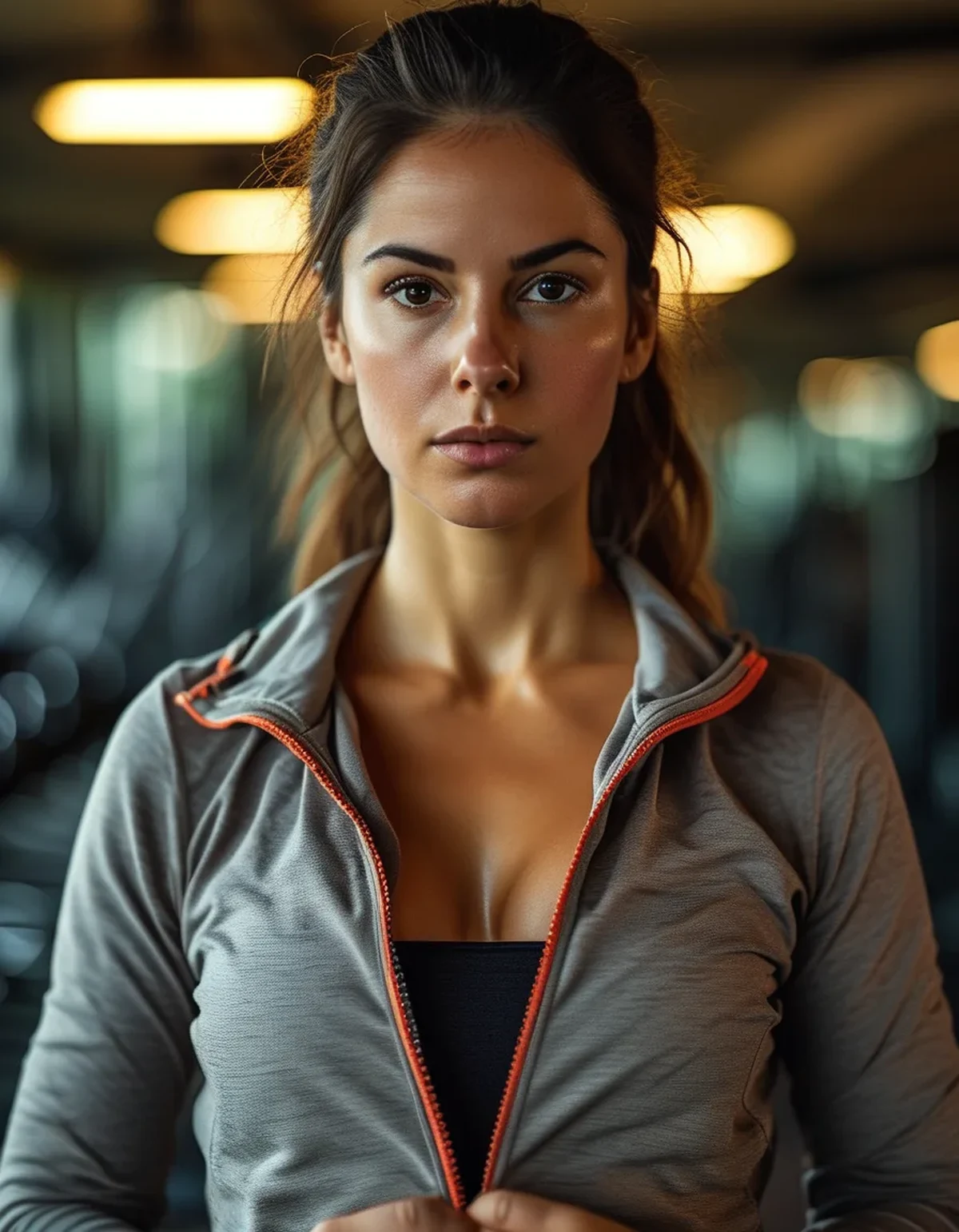
Zip length is the first specification, not the last. A quarter zip vents the neck and upper chest; a half zip vents most of the torso; a full zip lets you use the layer at any temperature at all. For a single do-everything layer, full or half is worth the extra.
A garage at the bottom of the zip - the small fabric guard at the chin - matters more than it sounds, because a zip that scratches your neck gets left open or closed at the wrong setting.
Two-way zips are genuinely useful for lifting, since you can open from the bottom while keeping the chest covered, which vents without letting cold air onto your neck.
A zip pull you can find without looking. If you have to look down and hunt for it between sets, you will not use it, and the whole system depends on adjusting often.
Fabric that breathes when open. A windproof shell vents beautifully at the zip and nowhere else, which is fine outdoors and stifling in a gym. A breathable knit vents across the whole surface plus the zip.
And check it moves with one hand. Anything that needs two hands or a held hem will not be adjusted mid-session, which is exactly when you need it.

How to use it across a session
Start closed and slightly too warm. Warming up in a closed layer raises tissue temperature faster, and the whole point of having a zip is that you can dump the excess in ten seconds.
Open a few inches at the first sign of sweat, not when you are already uncomfortable. Venting early keeps the base layer drier, and a dry base layer is what stops you chilling later.
Open fully during work intervals and close during rest. This is the pattern that removes the cold-between-sets problem entirely, and it is more effective than any single choice of layer weight.
Close it before you finish, not after. Trapping heat during the last few minutes means you leave warm rather than starting to cool while you pack up.
Different for lifting than for cardio. Lifting has long rests where you cool quickly, so you want more closing and opening; steady cardio is a single state and mostly wants a fixed partial opening.
With mornings starting to cool over the next few weeks, a full-zip layer becomes the single most useful piece in a gym bag - it covers a cold walk in, a warm session, and a damp walk home without you carrying anything else.
FAQ: Zips and Gym Layering, Answered
Does opening a zip really cool you that much?
Yes, disproportionately - the chest, upper back, and neck lose heat quickly, and a partly open zip creates airflow over damp skin. That evaporative cooling is what produces the effect, not the small amount of fabric moved.
Quarter zip or full zip?
Full or half if it is your only layer, since it works across a much wider temperature range. A quarter zip is fine as a second, lighter option.
Should I start warm or cool?
Start closed and slightly too warm. Warming up in a closed layer raises tissue temperature faster, and you can vent the excess in seconds.
Why do I get cold between sets even when I am sweating?
Because a damp base layer keeps cooling you once you stop working. Venting early keeps it drier, which is more effective than adding warmth on top.
Is a windproof layer good for indoor training?
Usually not. It vents only at the zip and traps moisture everywhere else, which is fine outdoors and stifling in a gym. A breathable knit is better indoors.
Does this work differently for lifting and cardio?
Yes. Lifting has long rests and benefits from frequent opening and closing; steady cardio is one state and usually wants a fixed partial opening.
What is the single best feature to look for?
A zip you can move one-handed without looking. Everything else is secondary, because a zip you do not adjust is just a collar.
TL;DR:
- A zip regulates continuously; a layer is binary, which is why layer changes overshoot in both directions.
- The chest, upper back, and neck are high heat-loss areas, so a small opening produces a large effect.
- Choose layers by zip length and one-handed usability rather than by warmth.
- Start closed, vent at the first sign of sweat, open during work and close during rest.
- A damp base layer is what chills you later, so venting early matters more than adding warmth.
As mornings cool over the next few weeks, one full-zip layer covers a cold walk in, a warm session, and a damp walk home.
Keep Reading
This article is for general informational and styling purposes only. Fit, sizing, and product availability may vary.