Why a Vest Beats a Jacket for Fall Gym Commutes

Quick Answer: Your torso needs to stay warm to keep blood flowing to your extremities, but your arms generate and dump heat far faster once you start moving. A vest keeps the core insulated while leaving the biggest heat-dumping surface free, which is why you overheat ten minutes into a jacket and not into a vest. Use a vest from roughly 45 to 60 degrees, and save the jacket for wind, rain, or genuinely cold air.
You leave the house cold, walk six minutes, and by the time you are at the gym door you are unzipping everything and slightly damp.
That whole cycle is a jacket problem, and it has a simpler fix than most layering advice suggests.

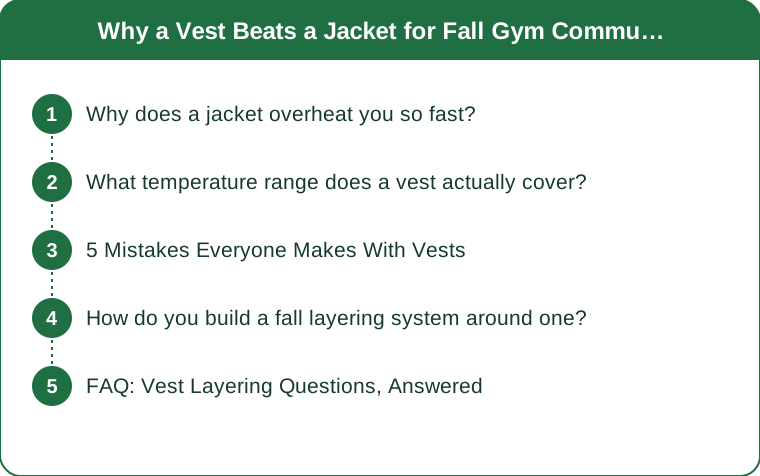
Why does a jacket overheat you so fast?
Because the arms are doing most of your thermal regulation and a jacket switches it off.
Arms have a very high surface area to volume ratio. They shed heat efficiently, which is exactly what your body wants once you start moving. Wrapping them in an insulating sleeve removes your largest fast-response cooling surface.
Arms move constantly, which drives air exchange. Every arm swing pumps air through and around the sleeve. That is a feature when the sleeve is breathable and a problem when it is a wind-blocking shell — the shell traps the humidity your arms are producing without letting it out.
The torso is where the body wants to protect heat. Your body’s priority is core temperature. Keep the core warm and it keeps sending blood to hands and feet. Let the core get cold and it constricts peripheral circulation, which is why cold hands are usually a torso problem in disguise.
So a vest matches what your body is already trying to do. Insulate the part that wants insulating, free the part that wants to dump heat. That is the entire principle, and it explains why a vest feels comfortable across a much wider temperature range than a jacket does.
It is also why so many runners end up in a vest by their second fall, usually after buying a jacket first.
What temperature range does a vest actually cover?
Wider than most people assume, and it overlaps heavily with the range where a jacket is uncomfortable.
Roughly 55-65 degrees: vest over a short sleeve. This is prime vest weather. The vest handles the standing-around cold at the start and gets unzipped rather than removed once you are moving.
Roughly 45-55 degrees: vest over a long sleeve. The most versatile combination in fall. The long sleeve handles arm warmth without trapping, the vest handles the core, and both layers are adjustable independently.
Below about 40 degrees: a jacket starts to make sense, particularly with wind. At that point arm heat loss stops being useful and starts being a problem.
Any temperature with meaningful wind or rain: shell first, regardless of the number. A vest does nothing for wind on your arms and nothing at all for rain.
Indoors afterward: a vest is far easier to keep on in a warm gym lobby than a jacket, which means fewer things to carry or stuff in a locker. That sounds trivial until you have left a jacket at a gym.
The practical result is that a single vest covers most of September through November for the majority of people in most of the country.

5 Mistakes Everyone Makes With Vests
1. Buying a puffy one for exercise. A thick insulated vest is a standing-around garment. For a commute where you will be walking briskly, a thin wind-resistant front with a breathable back panel does far more. The back panel is the part people never check and the part that decides whether you sweat.
2. Sizing it like outerwear. A vest worn over a base layer should be close-fitting. Extra volume at the waist means air pumping in and out with every step, which defeats the purpose. This is one of the few layers where snug genuinely outperforms roomy.
3. Ignoring the zip. A full-length two-way zip lets you vent from the bottom while keeping your chest covered — the single most useful adjustment in shoulder season. A quarter-zip pullover vest gives you almost no regulation.
4. Treating it as warm enough for the whole session. A vest is a commute and warm-up garment. Keeping it on for the working sets is how the third mistake compounds into a soaked base layer you then have to walk home in.
5. Forgetting pockets are the real feature. Phone, keys, and a card, all secured and accessible while your hands stay free. For a walk or ride to the gym, that alone justifies it.
How do you build a fall layering system around one?
Three pieces that cover almost everything from September to November.
Base: a fitted long sleeve in merino or a technical knit. This does the actual temperature work. Cotton here is what makes people miserable on the walk home, because it holds sweat and stays cold.
Mid: the vest. Close fitting, breathable back, two-way zip, real pockets. This is the piece you adjust constantly and it should be easy to adjust while walking.
Shell: a thin packable wind layer, carried not worn. For the days it turns. This lives in your bag and weighs nothing.
Adjust in this order: unzip the vest, push up the sleeves, remove the vest, and only then consider the base layer. Most people go straight to removing everything, which is why they get cold five minutes later.
Zip position is the underrated control. Halfway open vents the chest, fully open with the vest still on keeps the wind off your kidneys and lower back while dumping heat from the front. That intermediate state is the one a jacket never gives you comfortably.
On the way home, put the vest back on before you leave the building, not after. A warm body in a cold wind cools much faster than you expect.
FAQ: Vest Layering Questions, Answered
Do I need a vest if I already have a jacket?
If your commute or warm-up is more than a few minutes and the temperature is above about 45, yes — you will use it far more than the jacket. The vest covers the large middle range where a jacket is too much and a single layer is not enough, which in most climates is the majority of fall.
Insulated or wind-resistant?
For active use, wind-resistant with a breathable back beats insulated almost every time. Insulation is for standing still. If you want one that does both, look for a thin synthetic fill on the front panel only.
Can I wear it for the actual workout?
For outdoor lifting or a cold garage gym, yes, and many people do. Indoors, take it off after your warm-up. Training in a vest indoors just means starting your working sets already sweating, which does nothing useful for you.
TL;DR:
- Arms are your fastest heat-dumping surface; a jacket blocks it, a vest does not
- A vest over a long sleeve covers roughly 45-60 degrees, which is most of fall in most places
- Buy close-fitting, wind-resistant front, breathable back, two-way zip — not puffy
- Adjust in order: unzip, push sleeves, remove vest, and put it back on before you step outside again
It is a smaller garment that solves a bigger part of the problem. If you only add one thing to the gym bag this fall, this is the one that changes the most days.
Keep Reading
This article is for general informational and styling purposes only. Fit, sizing, and product availability may vary.