Why Your Layers Feel Perfect in the Car Park and Wrong by the Second Set

Quick Answer: You dressed for a steady-state activity and then did an intermittent one. Walking from the car produces constant low heat; lifting produces sharp heat spikes during sets and rapid cooling between them. A layering system built for the walk traps heat during the set and then leaves you clammy during the two-minute rest. Lifting needs a system you can open and close in one movement, not one you have to fully remove.
The practical version: one thin base you never take off, one mid layer with a full zip, and nothing that has to come off over your head.
Here is why the usual approach fails and what replaces it.

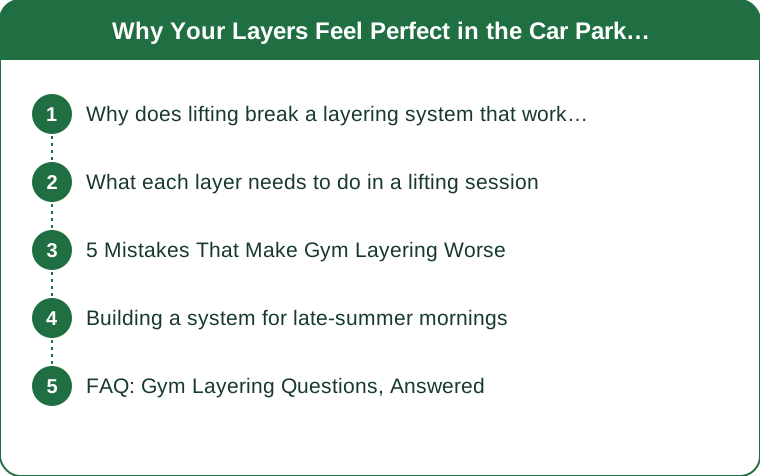
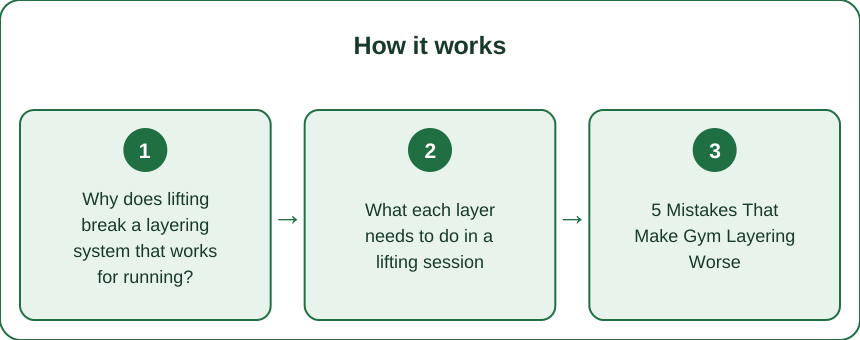
Why does lifting break a layering system that works for running?
Because the heat pattern is completely different, and almost all layering advice was written for continuous cardio.
Running produces steady heat and steady airflow. You warm up over ten minutes, stay warm, and the air moving past you removes moisture continuously. A three-layer system works because the conditions barely change for the next 40 minutes.
Lifting produces spikes. A hard set raises your core temperature sharply over 30 to 60 seconds, and then you stand still for two or three minutes. Repeat twenty times. Your body is asking for two different outfits every three minutes.
And there is no airflow. Standing under a bar in a heated gym, nothing is moving across the fabric, so evaporation slows dramatically at exactly the moment you produced the most sweat. This is why you feel wet in a way you never do on a run.
The rest periods are where it gets uncomfortable. Damp fabric against skin in still air cools you fast - which feels fine for 30 seconds and then genuinely cold by minute two, particularly across the shoulders and lower back.
Meanwhile the warm-up problem is the reverse. People arrive cold and want to stay layered, then overheat during the second warm-up set and strip everything off before they are properly warm. You end up cold for the working sets, which is the exact opposite of what you wanted.
What each layer needs to do in a lifting session
Three pieces, and each one has a job that is different from its running equivalent.
The base layer - stays on all session. Thin, snug, and technical or lightweight merino. Its whole job is moving moisture off your skin so that the rest periods do not chill you. Cotton fails here decisively - it holds the sweat against you and turns every rest period into a cold one. Snug matters because a loose base cannot wick from skin it is not touching.
The mid layer - full zip, opens and closes constantly. This is the piece doing the real work. A full zip lets you dump heat during a set by opening it and recover between sets by closing it, without ever taking anything off or putting a barbell down. A pullover hoodie cannot do this, which is why the most popular gym garment is the wrong one.
The outer layer - for the car park, not the gym floor. Comes off in the changing room and goes back on when you leave. The mistake is treating it as part of the workout system; it is transport equipment.
The often-missed piece: something for the lower back. A base layer long enough to stay tucked through hinging and squatting is worth more than most people realise. The lower back is the area most exposed during deadlifts and the first to feel cold in a rest period.
And sleeves that push up and stay. A sleeve that slides back down mid-set is a small annoyance twenty times per session. Fitted cuffs solve it.

5 Mistakes That Make Gym Layering Worse
1. Warming up in the outer layer to ‘break a sweat’. You do not want a sweat before you start - you want warm muscle and dry skin. Sweating during the warm-up means your base layer is already saturated before the first working set, and everything after that is damage control.
2. Wearing a pullover hoodie. It is the default gym garment and it cannot be adjusted. Anything you have to take off over your head will stay on too long, because taking it off mid-session is inconvenient enough that you will not do it.
3. Cotton anywhere in the system. Especially the base. Cotton holds many times its weight in moisture and gives it up slowly, which turns every rest period into a cooling period. This single swap fixes more discomfort than any other change.
4. Layering thick instead of layering thin. Two thin layers regulate far better than one thick one, because you have a middle setting. One thick layer gives you on or off, and neither is right.
5. Ignoring the commute back. You finish warm and damp, then walk to a cold car in the same base layer. A clean dry layer to change into for the journey home is the most underrated item in a gym bag - and the reason people feel chilled for an hour after a good session.
The fifth one is the one everybody knows and nobody does.
Building a system for late-summer mornings
Right now is the awkward season - cool starts, warm afternoons, and a gym that has not switched its heating logic yet. This is the specific case that breaks most people’s setup.
The morning session, 55 to 65°F outside:
- Base: thin technical long sleeve or fitted tee, long enough to stay tucked
- Mid: lightweight full-zip. Open for sets, closed for rests. This layer alone handles a 15 degree swing
- Outer: whatever gets you to the door. Off before you touch a weight
- Extras: a spare dry tee for the journey home
The afternoon session, warm and humid: base layer only, plus the full-zip in the bag for the air-conditioned parts of the building. Air conditioning is the reason people get cold in August gyms, and a thin zip layer costs nothing to carry.
How to adjust in real time:
- Zip up during rest, unzip during the set. Make it a habit and you will stop noticing temperature entirely
- If you are cold at rep one of the working set, add a layer rather than working harder - being cold under load is a genuine injury-risk factor, not just uncomfortable
- If your base is soaked by the halfway point, you started too warm. Take a layer off during the warm-up next time, not after
- Judge by your hands and lower back, not your torso. Those cool first and are the honest signal
The one-sentence rule: dress so that you feel slightly cool during your first warm-up set. If you are comfortable at that moment, you will be too hot within ten minutes.
FAQ: Gym Layering Questions, Answered
Should I keep my jacket on for the whole warm-up?
Keep it on for general warm-up and take it off before the first working set. The purpose of the layer is to get tissue warm quickly, not to make you sweat, and being damp before you start working is what causes problems later.
Is merino worth it for lifting specifically?
It is, mainly for the rest periods - merino holds a substantial amount of moisture as vapour before it feels wet, so the clammy-then-cold cycle is much less pronounced. The odour resistance also matters if you train several times a week.
Why do I get cold in a heated gym?
Because a heated room with no airflow slows evaporation while you are working and then chills damp fabric the moment you stop. It is a moisture problem wearing a temperature costume, and the base layer fixes it.
Do I need different layers for cardio and lifting on the same day?
Usually just one adjustment - open everything for the cardio portion, close the mid layer for the lifting portion. If you do cardio first, expect to be considerably warmer for the first few lifting sets and dress for the lifting, not the treadmill.
TL;DR:
- Lifting produces heat spikes and cold rest periods, unlike the steady heat of running
- One thin technical base stays on all session; cotton is the main culprit in feeling clammy
- A full-zip mid layer lets you adjust between sets without removing anything
- Aim to feel slightly cool at your first warm-up set - comfortable then means overheating soon
- A dry layer for the journey home is the most skipped and most useful item in the bag
Next session, swap your hoodie for anything with a full zip. It is a smaller change than it sounds and it fixes most of this.
Keep Reading
This article is for general informational and styling purposes only. Fit, sizing, and product availability may vary.