Moisture-Wicking vs. Cotton for Gym Layering: What Actually Happens to Each
Quick Answer: Moisture-wicking synthetic fabrics pull sweat away from skin and spread it across the fabric surface for faster evaporation, while cotton absorbs and holds sweat against the skin, becoming heavier and staying damp — this difference compounds in a layered outfit, since a damp cotton base layer keeps the layers above it wet and cold as well, instead of staying dry.
The cotton problem isn’t really about the cotton alone — it’s about what a wet base layer does to every layer stacked on top of it.
Why does moisture-wicking fabric actually pull sweat away instead of absorbing it?
Synthetic wicking fabrics use capillary action, moving moisture along fiber channels to the fabric’s outer surface where it can evaporate, rather than absorbing it into the fiber itself the way cotton does. This keeps the layer next to your skin comparatively dry even during heavy sweating, since the moisture is being actively moved away rather than held in place.
How does a wet cotton base layer actually affect the layers above it?
Cotton can absorb significantly more than its own weight in moisture and holds onto it, meaning a damp cotton base layer transfers that dampness outward to whatever’s layered on top through direct contact, compromising the insulating or wicking properties of an otherwise good outer layer. This is why a single cotton piece in an otherwise well-chosen layering system can undermine the whole setup.
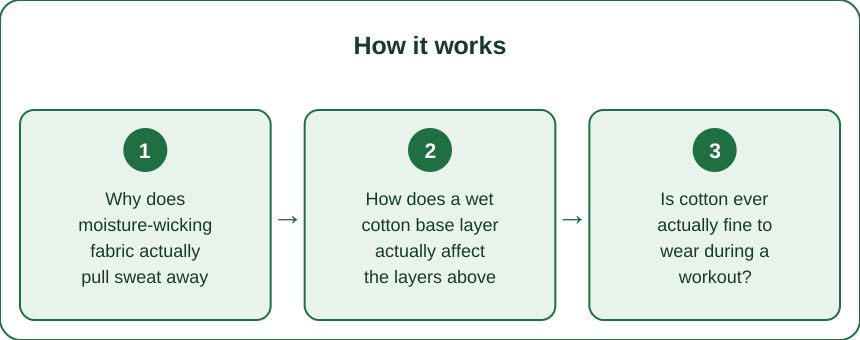
Is cotton ever actually fine to wear during a workout?
For low-intensity activity with minimal sweating, cotton’s downsides are much less relevant, since the moisture volume that triggers the problem never builds up. The issue scales specifically with sweat volume and layering — a single cotton t-shirt on a walk is a very different situation than a cotton base layer under multiple layers during an intense session.
TL;DR:
- Wicking fabric moves sweat to the surface for evaporation; cotton absorbs and holds it
- A damp cotton base layer transfers moisture outward, compromising layers above it
- The problem scales with sweat volume — light activity makes cotton’s downsides less relevant
- In a multi-layer gym outfit specifically, the base layer fabric choice matters most
If you’re layering for a genuinely sweaty session, the base layer — the piece actually touching skin — is the one place synthetic fabric choice matters most.
Keep Reading
This article is for general informational and styling purposes only. Fit, sizing, and product availability may vary.